Start with the gate, not the opener
An operator is a motor that pushes and pulls. It does not lift, straighten, or square anything, so it inherits every flaw the gate already has. A leaf that drags or binds makes the operator strain on every cycle, which wears gears and arms out early. Worse, most operators sense an obstruction partly by how hard they have to work. A gate that binds trips that sensing and reverses for no visible reason, and the tempting fix, turning the force up, means the gate also pushes harder against a car or a person in its way. If your gate already has an opener that quit, repair versus replacement is a separate question with its own guide.
The checks that make a good candidate
You can run most of these yourself in a few minutes. Unlatch the gate and move it slowly through its full travel with one hand, pushing from the latch end, then look over the hinges and posts. What you feel and see tells us most of what we need to know, so note anything that sticks and mention it when you call.
- Free travel: it swings or rolls the whole way, open to closed, with a steady push and no lifting, scraping, or catching.
- No drift: a swing leaf stays where you leave it. One that wanders open or closed on its own usually has hinges or a hinge post out of plumb.
- Sound hinges and posts: no slop at the hinges, no lean or rock in the hinge post, no rot at the base of a wood post. Once automated, that post carries the operator's push as well as the gate's weight.
- A square leaf: the gap on the latch side is even from top to bottom and the latch end has not dropped. A sagging leaf is a common fix before automation.
- Clear ground: nothing in a swing gate's arc, including a high spot, a rutted gravel patch, or a driveway that rises behind the gate. A slide gate needs clear, level room along its whole run.
- Slide hardware: rollers that turn freely, a track or cantilever carriage in good shape, and a panel that runs level.
What actually gets added to your gate
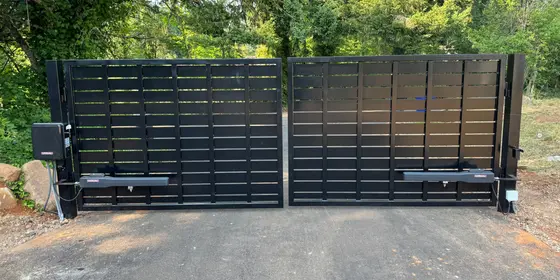
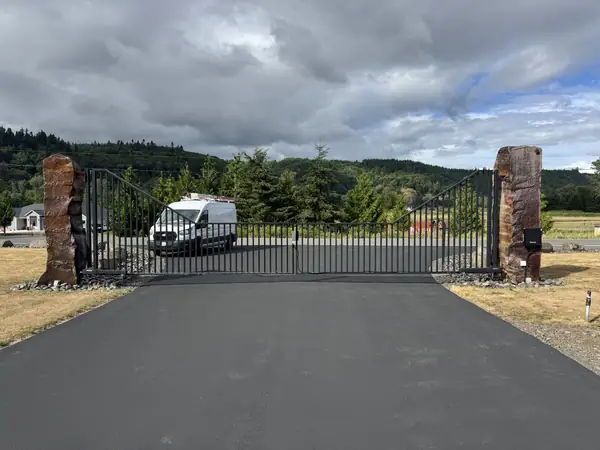
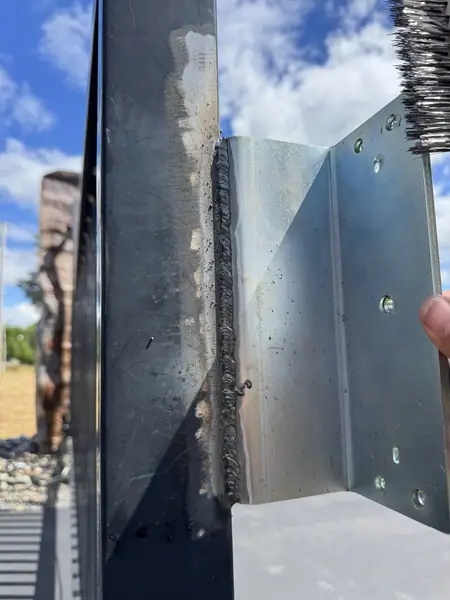
Automating an existing gate is mostly a matter of adding the right parts in the right places. On an iron double gate hung between stone pillars, we welded operator mounting brackets to the gate frame, mounted LiftMaster swing operators, and mounted the control box beside the pillar. On a return visit we fitted an electric lock where the two leaves meet. Both leaves now open on their operators, and the lock holds them shut. Most jobs include some version of each item below.
- Operator mounting brackets: the operator's maker specifies where the arm attaches relative to the hinge, and that spot needs solid steel, so we often weld a bracket to the frame instead of clamping one on.
- The operator itself, sized to the gate's weight and length and to how often it will open, mounted on the post or pillar, or on a pad beside a slide gate.
- A control box for the board, receiver, and wiring connections, placed where it stays protected and reachable for service.
- Safety devices: UL 325 calls for monitored entrapment protection, meaning photo eyes, contact edges, or both, covering the opening and the spots where the gate could pinch.
- A lock, on some gates: where two leaves meet, or on a long or solid leaf that catches wind, a lock holds the gate closed so a gust or a shove loads the lock instead of the operator's arm and gears.
When the gate needs work first
Plenty of gates fail a check or two and are still worth keeping. The fixes are fabrication and hanging work, and we do that in-house, in our own shop and with our own crew, so you are not lining up a welder, a fence contractor, and a gate company. We will also tell you plainly when a gate is past saving, or when a new leaf makes more sense than rebuilding an old one. Typical work before the operator goes on:
- Re-hanging a sagging leaf and replacing worn hinges, often with heavier ball-bearing hinges rated for the leaf
- Squaring a racked frame and adding a diagonal brace or reinforcement where it flexes
- Re-welding cracked joints and cutting out rusted-through sections
- Resetting or replacing a hinge post that leans or rocks
- Adding a steel frame or reinforcement plate to a wood gate so the operator has something solid to push on
- Adding gate stops, and on slide gates the screening, roller guards, and positive stops that ASTM F2200 calls for
How your gate type changes the plan
The checks are the same for every gate, but the hardware and the trouble spots change with the way the gate moves. A farm gate, an iron double gate, and a slide gate on a cantilever carriage are three different jobs even when they close off the same width of driveway. Here is how each one usually goes and what we watch for.
- Single swing: the simplest case. One operator on the hinge post, one set of brackets, and an arc that has to clear the ground all the way across.
- Double swing: two operators on one control, with a short delay set so the leaves close in the right order and meet cleanly, two leaves that hang true to each other, and often a lock where they meet.
- Slide: a toothed rack or chain fastened along the panel for the operator to drive, a pad or post for the operator beside the opening, and rollers and track or carriage that run smoothly. Older slides often need mesh screening on the panel and guards over the rollers.
- Farm gates: long tube gates are light but can flex, so the arm has to attach where the frame is stiff, and gravel ruts in the arc need attention. One farm job was a new gate, not a retrofit: in Beavercreek, the hand-opened pipe farm gate came out, and we ran conduit from the barn, hung a new farm gate across the drive, and mounted a LiftMaster swing operator and control box on the hinge post, over two days.
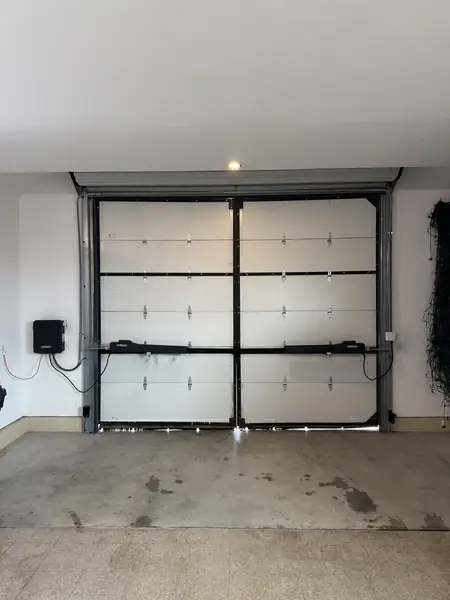
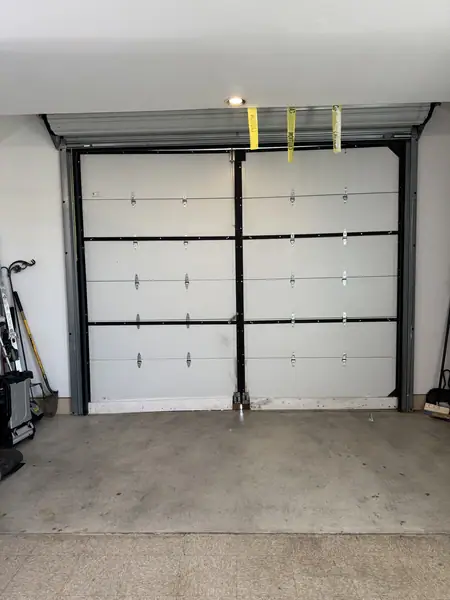
- Unusual openings: in Camas we automated a pair of swing-out carriage garage doors. They swing outward like a pair of gates, so we treated them like a gate: a LiftMaster swing arm on each door, mounted inside, and a control box on the garage wall.
What the visit looks like, and when it takes two
It starts with a free on-site estimate. We run the hand test with you, measure the leaf, check the hinges, posts, and ground, and talk through where the operator and control box will sit. You get a written, itemized quote that keeps any repair work separate from the automation. The job itself often splits across visits: one to look and one to install, as with the Camas garage doors, or operators first and a lock on a return trip, as with the stone-pillar gate. Shop work happens in between. If there is no power at the gate yet, trench or solar is its own decision with its own guide. Once the gate runs, it opens with whatever you chose in the quote: remotes, a keypad, your phone, or an intercom.
Frequently asked questions
What happens to the latch and drop rod on my gate once it is automated?
They come off or get disabled. An operator cannot lift a latch or pull a drop rod out of the ground, so it would drive the gate against them and either stall or bend something. On many single leaves the operator's drive holds the gate closed on its own. On a double gate, or a long or solid leaf, we usually replace the manual hardware with an electric lock that releases when the gate is told to open.
Can I still open the gate by hand after it is automated?
Yes, but not by pushing it while the operator is engaged. The drive holds the leaf in place, and forcing it strains the gears and the arm. Every operator has a manual release, usually key-operated, that disconnects the drive so the gate moves freely by hand. Use it during an outage or for service, then re-engage it. Have the installer show you where yours is and how it works.
My gate swings out toward the road. Can it still get an operator?
It can, if the site allows. Arm operators can be set up to pull a leaf open outward instead of pushing it inward, and the mounting changes to suit. The limits are firm, though: the leaf should never swing over a sidewalk or public right-of-way, and a car waiting for the gate needs to sit clear of the arc. Where that does not work, reversing the swing or moving the gate up the driveway becomes the conversation.
Can I automate one leaf of a double gate and leave the other alone?
It can be done. The automated leaf becomes your everyday opening and the other stays bolted or locked closed, opened by hand when you need the full width for a trailer. It works best when the active leaf alone is wide enough for the vehicles you drive every day. The fixed leaf still has to be held securely, because the moving leaf closes against it.
My gate is wood. Can it still take an operator?
Many wood gates can, as long as the frame is rigid. Wood soaks up winter rain and gains weight, and a board gate that has started to sag will only sag faster with a motor working it. The operator also needs something solid to attach to, so wood gates often get a steel frame or a reinforcement plate at the bracket point first, built in our shop. Solid board gates catch wind, which affects operator sizing and whether a lock is worth adding.
 Before
 Start