Symptoms that usually mean one failed part
Most opener failures start with a single component, and on an operator that is otherwise in decent shape, replacing that part is the sensible move. If you are stuck behind a dead gate right now, start with the safe checks in our guide on why a gate won't open; this guide picks up after those. The faults we fix most often:
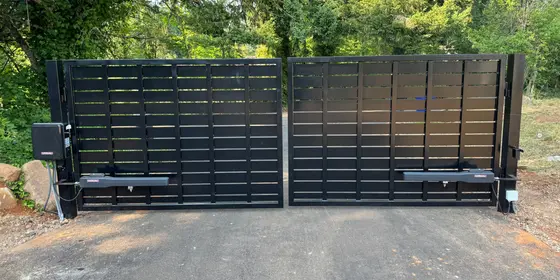
- Control board: the gate died during a storm or a power blip, or it ignores every input while the motor itself is fine. Surges and moisture are the usual causes.
- Limit switch or limit settings: the gate stops short, overruns its open or closed point, or reverses at the end of travel.
- Backup battery: the gate quits during every outage, or a battery-driven operator slows down and struggles.
- Motor capacitor: on AC operators, a motor that hums but won't turn often has a failed capacitor, not a failed motor.
- Arm or chain hardware: worn pins, bent brackets and loose arm bolts on a swing operator, or a stretched chain and worn sprocket on a slide operator, cause noise and jerky travel long before the motor is at risk.
- Photo eyes, receivers and other accessories: one failed device can make a perfectly good operator look dead.
When the operator itself is at the end of its life
The picture changes when the wear is in the parts that do the heavy lifting, or when failures stop arriving one at a time. A new motor or gearbox in an old housing can cost close to a whole new operator, and it leaves you with the same old board, the same corroded connections and the same safety equipment. Parts availability is the other half. Once a manufacturer discontinues a model, the board you need may be scarce, used or gone. Sometimes a retrofit board fits the old housing. Sometimes nothing does, and that alone settles the question.
- The gearbox grinds, slips or has stripped teeth, and the motor runs hot or trips out after a few cycles.
- Rust has eaten into the housing or mounting, and water finds its way into the control box every rainy season.
- You have replaced two or three different parts in a short span, and something new fails each time.
- The unit predates monitored entrapment protection and cannot work with current safety devices.
An opener that keeps dying is often undersized
If you are on your second or third operator on the same gate, the gate is telling you something. Operators are rated for gate weight, gate length and duty cycle, meaning how many cycles they can handle in an hour without overheating. Put a light residential unit on a long iron gate, or on a shared driveway that opens all day, and it runs at the edge of its rating every time it moves. It wears its gears, cooks boards and dies early, and an identical replacement starts the same countdown. Weather piles on: a solid panel catching east wind off the Gorge, or a cedar gate heavy with a winter of rain, adds load the original sizing may never have counted.
Old operators and current safety requirements
Gate operators sold today are listed to UL 325, and its current edition calls for monitored entrapment protection: photo eyes, contact edges or both, which the operator actively checks. If a monitored device is missing or faulted, the gate will not run normally. Plenty of older operators around Portland and Clark County predate that requirement, with sensors the board never supervised or no sensors at all. Repairing one isn't wrong, but if it cannot work with monitored devices, you are paying to keep a gate running at an older safety level. Whether the operator can protect a person in its path weighs as much as the price of the part. We never disable a safety device to get an old operator moving.
What a replacement visit involves when the gate stays
When the gate, posts and pad are sound, an operator swap is a much smaller job than a new installation: little or no fabrication, no new footing, and usually no new trench. The old unit comes off, the new one goes on, the wiring lands on the new board, and then travel limits, force settings and every safety device get set and tested before anyone leaves. Here is what changes by operator type, and two jobs that show the scale.
- Slide operators: the new unit bolts to the existing concrete pad, often on new anchors, since mounting patterns differ between brands and models. The chain is replaced or re-tensioned and aligned, and chain brackets on the gate usually stay if they are sound.
- Swing arm operators: new brackets go on the post and the gate leaf, placed to suit the new arm's geometry. When the old mounting points don't suit, we fabricate brackets in-house.
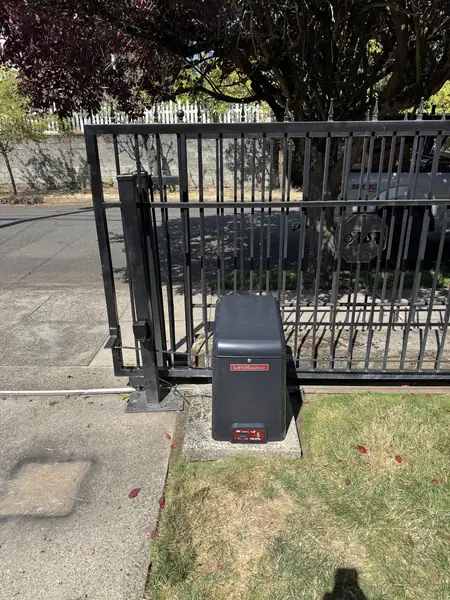
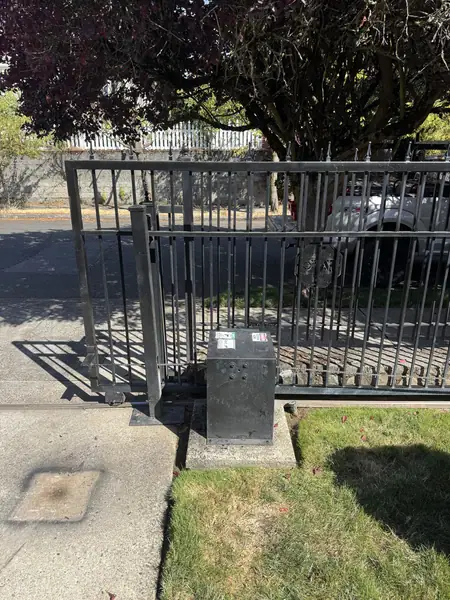
- In Portland: the black iron slide gate was fine, the operator was done. We set a new LiftMaster slide gate operator on the same concrete pad, and the gate was sliding under power about three hours after we started.
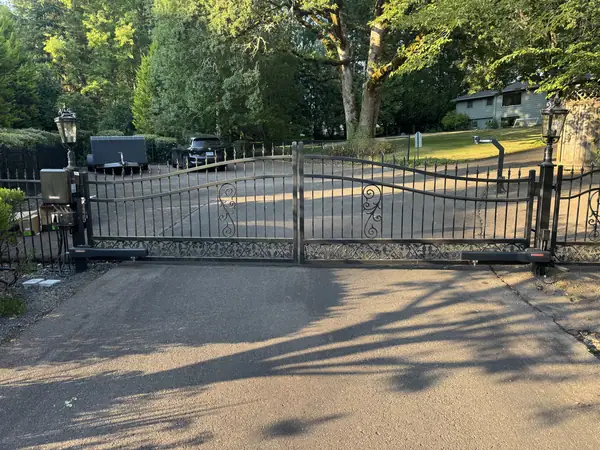
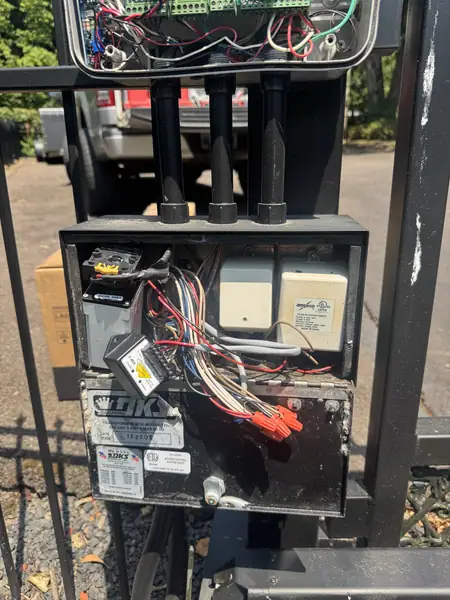
- In Lake Oswego: worn operators and an old DoorKing control box came off an arched iron double swing gate, and a new LiftMaster control box plus a LiftMaster swing arm on each leaf had it opening under power the same day.
What usually carries over, and what doesn't
On a swap, the money goes into the operator and its electronics, not into concrete and steel. The permanent parts of the system almost always stay. Some of the electronics and accessories do not, and knowing which is which before the quote arrives makes every line item easier to read. Here is how it usually shakes out on the driveways we see.
- Usually reused: the gate itself, the posts, the concrete pad, and the conduit that carries power and low-voltage wire.
- Often reused: buried wire and vehicle loops that test good (the loop detectors may change), plus wired keypads and intercoms that trigger the gate through a simple dry-contact input.
- Usually replaced: the old control board. It belongs to the old operator and will not run a new one.
- Often replaced: remotes, since a new operator's built-in receiver may not learn older remote formats. An add-on receiver can sometimes keep them.
- Often replaced: older photo eyes and edges that cannot be monitored by the new operator.
- Worth adding while the box is open: battery backup and surge protection, if the old unit had neither.
What to tell the installer when you call
A few details on the phone let us bring the right operator class and the right parts on the first trip, and sometimes they settle repair versus replace before anyone drives out. A photo of the label and a plain description of what the gate does are worth more than a guess at what broke. You don't need the technical terms.
- Brand, and model if you can find it: photograph the label on the housing or inside the cover.
- The symptom in plain words, and whether it started suddenly or has been building for months.
- Roughly how old the operator is, if you know, and whether it has been repaired or replaced before.
- The gate: slide or swing, single or double, rough length, and what it is made of.
- How it is powered (hardwired or solar) and what opens it: remotes, keypad, intercom, loops.
- How many times a day it runs, especially on a shared drive or business entrance.
Frequently asked questions
Can I switch to a different brand when I replace my operator?
Yes. The gate doesn't care whose motor moves it, so a swap can go from one brand to another as long as the new operator is rated for the gate's weight, length and daily use. Our Lake Oswego job went from a DoorKing control box to a LiftMaster system on the same gate. What changes is the mounting hardware, the board and sometimes the remotes, which is why a brand change gets planned on site rather than ordered blind.
Will my existing remotes work with a new operator?
Sometimes. A remote has to speak the same radio format as the receiver, and older remotes often use formats a new operator's built-in receiver won't learn. An add-on receiver can bridge the gap and keep a large set of existing remotes working, which matters on HOA and multi-tenant gates with dozens in circulation. For a household with two or three remotes, new ones programmed on install day are usually simpler.
Should I replace an aging operator before winter or wait until it dies?
If it shows end-of-life signs, such as grinding gears, slow travel or a model with no parts left, replacing it on your schedule beats replacing it on the gate's. Wet Northwest winters and storm outages are when tired operators quit, often with a car on the wrong side. If it runs well and parts are available, there is no reason to retire it early. A service visit tells you which group yours is in.
On a double swing gate, can I replace just the operator that failed?
Sometimes. If the failed unit is a current model and an identical replacement is available, a single operator can be swapped. On older systems, both leaves usually get replaced together: the pair runs from one control system that expects matched operators, and the old arm left in service tends to be the next service call.
Is an operator replacement a good time to add battery backup or an intercom?
It is the easiest time to do it. The control box is open, the board is new and the wiring is being terminated anyway, so adding battery backup, surge protection, a keypad or a video intercom is mostly a matter of planning the connections. Battery backup earns its place here, given how often winter storms knock out power around Portland and Clark County. Mention what you want on the phone so the right parts come on the truck.
 Before
 Before