Why all-wood gates sag, and what the steel frame does
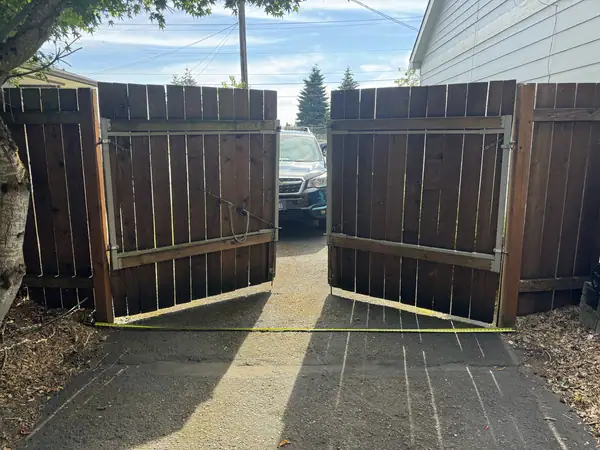
A swing gate hangs from one side, so its whole weight pulls the far corner down, and only the joinery in the frame resists it. Here, wood soaks up water every winter and dries out every summer, and each cycle swells and shrinks it around the screws and bolts. The joints loosen a little at a time, the latch side drops, and the gate starts dragging or missing its latch. A welded steel frame takes the wood out of the structural job. The steel carries the load and stays square, and the cedar becomes infill: it gives you the look and the privacy, but it is not holding anything up.
The common builds, and what each is like to live with
Each of these can be built well or badly, and each has a place. What changes from one to the next is weight, privacy, upkeep, and how the gate behaves when the weather turns. All of them can be automated, though not all with the same equipment. Here is the short version of each, the way we would describe it standing in your driveway.
- Cedar boards in a welded steel frame: the warm wood look, full privacy, and a frame that stays square. Fully boarded, it is one of the heavier residential builds, and the cedar needs periodic care to keep its color.
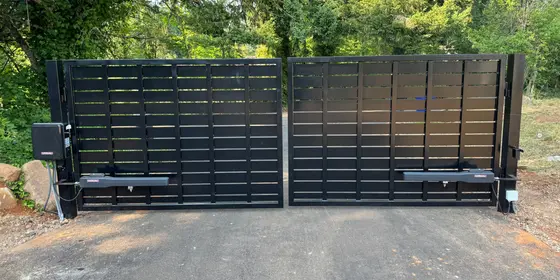
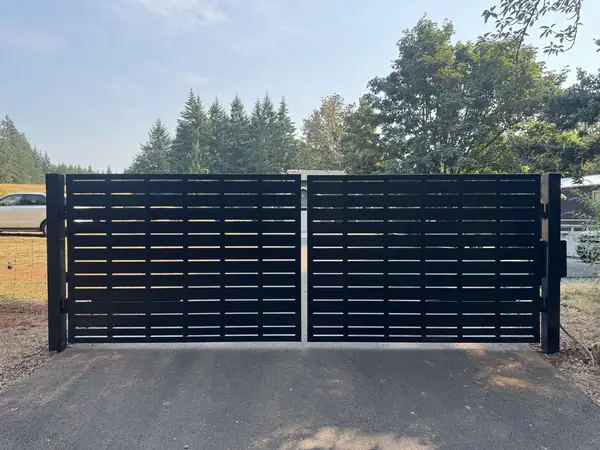
- All-steel with horizontal slats or vertical pickets: clean lines and little upkeep under a good powder coat. Near Beavercreek we fabricated a pair of black horizontal-slat steel gates from raw steel for a long rural driveway and automated both leaves with LiftMaster swing operators.
- Ornamental or arched steel, the iron look: arched tops, scrollwork, and custom details. Near Fern Prairie we built an arched black steel double swing gate with a custom medallion on each leaf, across a gravel orchard drive. More detail means more welds to keep an eye on.
- Aluminum: lighter, rust-free, and easy on hinges and operators, a good fit for long swing leaves and wet sites. The trade is stiffness: it flexes and dents more easily than steel.
- Chain link: the utility option for shops, storage yards, and commercial lots. Light and simple to automate, but it hides nothing and rarely suits the front of a home.
Privacy versus wind: the trade with a solid leaf
A solid board gate gives you the privacy most people want from a wood gate, and it also catches every gust. A gust on a solid leaf is magnified by the leaf's length: the force lands on the hinges, the hinge post, and the operator arm, and on a hard day it can stop an operator partway open or make it reverse. Toward the Gorge, from Troutdale to Camas and Washougal, east wind makes that load a real design factor. Open slats and pickets let most of the wind through, so everything works less. For privacy in a windy spot, there are middle paths.
- Gapped boards or spaced slats: screening from most angles with far less sail.
- Privacy where it counts: a solid lower section with open pickets or slats above.
- Heavier posts, footings, and hinges sized for the wind load, if the gate truly has to be solid.
Weight, hinges, and automating later
Weight is where the material quietly sets the rest of the job. A leaf filled solid with cedar weighs more than the same size gate in open steel pickets, and wood gets heavier still when it is soaked through. Aluminum sits at the light end. That weight, plus leaf length and wind load, decides how big the hinge posts and footings need to be, what grade of hinge carries the leaf, and which operator class can move it without straining. A light residential operator that is fine on an aluminum picket gate can be the wrong tool for a long, solid cedar leaf. Pick the gate first, then size everything else to it.
- If an opener might come later, say so now. The frame can be reinforced where the operator arm will mount while it is still in the shop.
- Set the hinge post and footing as if the gate were automated from day one. Upgrading a post later means breaking concrete.
- Ask for a build to ASTM F2200, the construction standard for automated vehicular gates, so the gate needs no safety rework when an operator goes on.
- If the ground is open for paving, that is the cheapest moment to lay conduit for future power.
Finishes and upkeep in a wet climate
Rain is the constant here, so the finish matters as much as the material. On steel, powder coating over properly cleaned and prepared metal is the standard: a baked-on coat far tougher than brushed paint. Steel rusts where that coating is broken, not across the face of the gate. Cedar is a different story. Left bare, it weathers from warm brown to silver-gray as sun and weather break down the surface, a look some people love. Cedar heartwood resists decay better than most softwoods, but no wood is immune to rot when it stays wet. Sealing or staining keeps the color and slows water uptake, and it is a recurring chore, not a one-time job.
- Check steel at welds, cut edges, drilled holes, and chips from gravel or mowers. Touch up bare spots early, before rust creeps under the coating.
- Keep cedar off the ground. The frame's bottom rail should hold the boards clear of soil, gravel, and splash-back, because end grain wicks water like a straw.
- Re-coat sealed or stained cedar when water stops beading on it. The sunniest, most exposed side usually needs it first.
- Use stainless or coated fasteners in cedar. Plain steel screws react with the wood and leave dark streaks.
- Clear fir needles, leaves, and moss off horizontal rails and slats, where they hold moisture against the finish.
Matching the pedestrian gate and fence panels
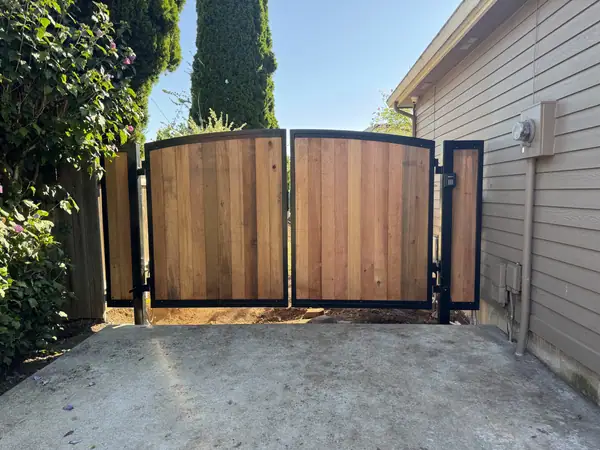
A driveway gate rarely stands alone. There is usually a walk gate nearby and fence running off both posts, and the entrance reads as one piece only when the frames, board widths, spacing, and finish all match. That is easiest when everything is designed and built together. In St. Johns we built a cedar double swing driveway gate, matching fence panels, and a pedestrian gate, all in cedar inside black steel frames, and all three went up in a single day. A week later we came back and added LiftMaster swing operators to the driveway gate. A separate walk gate also gives people their own way in, out of the automatic gate's path, which UL 325 expects.
Which one fits: the short rundown
Most driveways sort themselves out quickly once you are honest about privacy, wind, upkeep, and whether an opener is in the plan. Here is how the choices usually pair up, before any design talk. It does not replace a look at the actual site, since slope, soil, and exposure can change the answer, but it narrows the field fast.
- Wood and full privacy in a sheltered spot: cedar in a welded steel frame.
- Wood in the path of Gorge wind: cedar in a steel frame with gapped boards or an open top section.
- Lowest upkeep: powder-coated steel slats or pickets.
- A statement entrance on acreage: ornamental or arched steel with custom details.
- Long swing leaves, a wet site, or a lighter operator: aluminum.
- An opener later: any of these, as long as the frame, hinge post, and leaf weight are set up for it now.
Frequently asked questions
Should I seal a new cedar gate right away or let it go gray?
Either works, as long as it is a deliberate choice. Letting it weather is the low-effort route: cedar turns silver-gray on its own, and the color stays fairly even if the whole gate gets similar sun. Sealing or staining holds the warm color and slows water uptake, but once you start, you are committed to re-coating. The product label sets when to apply it and how often to redo it.
Can new cedar boards go into my existing steel gate frame?
Often, yes. If the steel frame is still square, the hinges are sound, and rust is limited to surface spots, re-boarding the frame is usually far less work than building a new gate. Have the frame checked first, since new boards on a racked frame just hang crooked in a nicer color. On an automated gate, heavier or more solid boarding also means rechecking the operator. It is also a good moment to refinish the steel.
Why are there black streaks around the screws on my wood gate?
That is usually a reaction between the wood and plain steel fasteners. Cedar contains natural tannins, and when rain carries them against uncoated steel, the result is dark staining that bleeds down from each screw. It is cosmetic at first, but a corroding fastener is also losing its grip. Stainless or properly coated fasteners avoid the problem, and they are worth insisting on for any cedar gate or fence.
Can I add privacy panels to an open picket gate later?
Physically, yes, but treat it as changing the gate, not decorating it. Filling in an open gate adds weight and turns it into a sail, so the hinges, hinge post, and operator suddenly carry loads they may not have been chosen for. On an automated gate, that can mean stalls and reversals on windy days. Have the setup checked before adding infill, and consider partial screening instead of a fully solid panel.
Is a heavier gate more secure?
Not by itself. A heavy gate is harder to push open by hand, but someone determined to get in will usually climb rather than push. Height, infill without easy footholds, the lock or operator holding the gate closed, and the fence on either side matter far more than weight. Horizontal slats, for example, can work like a ladder, which is worth weighing if keeping people out is the main goal.
 Start
 Before
 Before