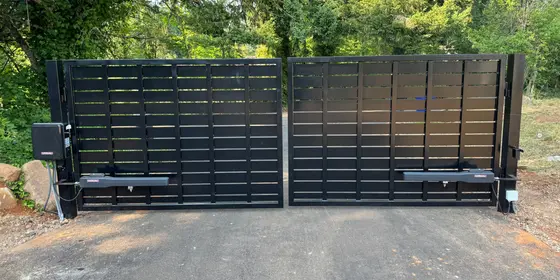
The first hour: stop, release, and keep people clear
The instinct is to hit the remote and see if it still works. Don't. A bent gate binds, and the operator doesn't know that. It keeps driving into the bind, which can strip gears, bend the operator arm, tear a hinge loose, or shove a slide panel off its rollers. A gate repair becomes a gate and operator repair. The safety devices may also be knocked out of line or crushed, so the gate can't be trusted to stop or reverse.
- Stop using remotes, keypads and the exit loop. If you can reach the operator's power switch or breaker safely, turn it off.
- If the operator housing is cracked open or wiring is exposed, keep everyone away and call. Exposed wiring is not something to touch yourself.
- Try the manual release only if the gate looks sound enough to move. If it binds or drags, leave it where it is rather than forcing it.
- Keep kids, pets and onlookers back. A leaf hanging from one damaged hinge, or a slide panel half off its track, can fall or roll without warning.
- Don't try to lift a slide gate back onto its track or rehang a leaf. Steel driveway gates can weigh hundreds of pounds.
Secure the opening, then document everything
Once nobody is at risk, deal with what the gate was protecting. A homeowner can often chain a gate closed with the operator off, or park a vehicle across the opening overnight. A storage facility, HOA entrance or business yard needs more, which is what a temporary gate is for. Then photograph everything before anything is moved or hauled away. Whoever pays, your insurer or the driver's, will want to see the damage as it was. We can't tell you what a policy covers or who is at fault, but good photos never hurt a claim.
- Wide shots from the street showing the whole gate and the opening
- Close-ups of every bent bar, cracked weld, hinge and latch
- The base of each post where it meets the ground, including any cracked concrete
- The track, rollers, operator arm, photo eyes and the operator itself, plus the label with the brand and model
- Any debris left behind, and the broken parts themselves; keep them
- The driver's name, plate and insurance details if they stopped, and the report number if police took one
How we assess a damaged gate
First we pin down where the damage lives: the infill, the frame, the posts or the machinery. Each one is a different repair. We check the frame for square by measuring corner to corner both ways; on a square frame, the two diagonals match. We sight down the leaf to see whether it still sits flat or has twisted. We photograph what we find, and you get a written, itemized quote you can hand to whoever is paying.
- Bent pickets or bars on a square frame: the best case. The bad bars get cut out and replaced.
- Racked frame: pushed out of square, so the diagonals no longer match. Often fixable in the shop.
- Twisted frame: the leaf no longer sits flat. Harder to correct, and a common reason a gate ends up replaced.
- Hinge posts that moved: a lean, cracked footing or gap at grade. No gate repair holds until the post is reset.
- Slide gates: bent bottom rail, flat-spotted or cracked rollers, damaged track or roller carriages, a bent gear rack.
- Operator: bent arm, torn mounting bracket, a base shifted on its pad, or internal damage from being driven backward.
What a shop repair involves
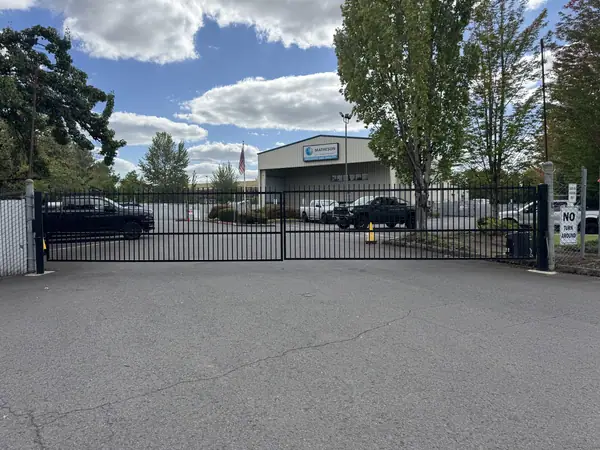
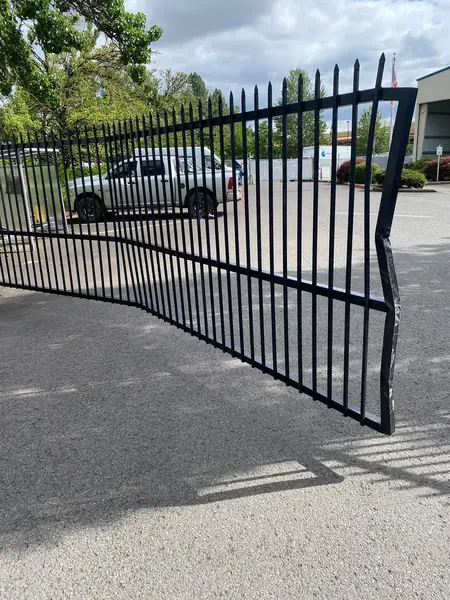
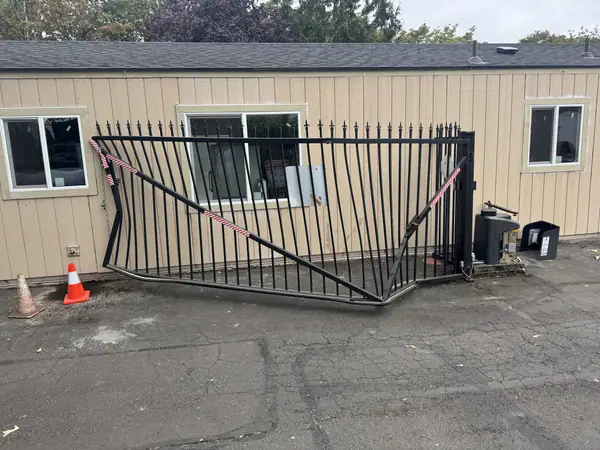
A bent steel gate rarely gets a lasting fix in the driveway. A kinked bar seldom goes back true, and heat or hammer work leaves bare steel that starts rusting in the first Northwest rain. So the gate comes down and goes to our shop. Bent bars are cut out, new ones are welded in at the original spacing, and the frame is brought back to square. Then the gate is typically sandblasted to bare steel and powder coated, so old and new steel carry one even finish. The method is the same whatever bent the gate. On a commercial double gate in Tualatin, one leaf was bent so far out of line that the two leaves no longer met in the middle. After new bars, sandblasting and powder coat, it closes straight across the lot entrance again.
Keeping the property closed while the gate is in the shop
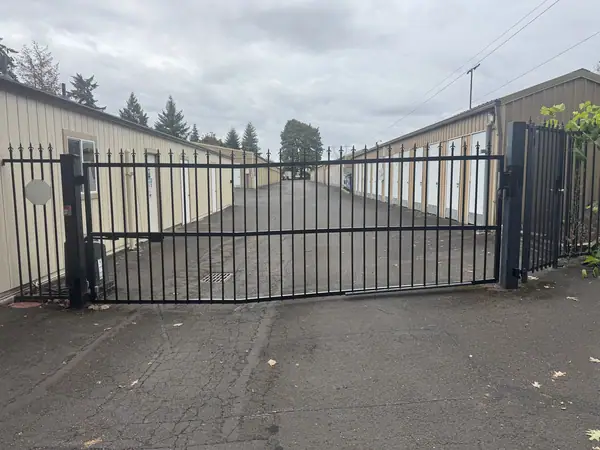
A shop repair takes the gate off site, and some properties can't stand open for even one night. For those, a temporary gate can go across the entrance before the damaged one is taken away. Take a self storage facility in Wilsonville whose swing gate was badly bent across the middle, with more damage at the operator end. We put a temporary gate across the drive, rebuilt the real one in our shop, powder coated it, and hung it back on the original post with the existing LiftMaster operator reconnected. From our first visit to back in service took about three weeks, and the lot stayed closed the whole time.
- A temporary gate is usually opened by hand, so keypads and remotes won't work it. Decide who holds the key or code to the lock.
- Tell tenants, residents and regular vendors how access works until the real gate is back.
- Keep the operator switched off until the real gate is back on it.
When replacement is the honest answer, and what changes with chain link
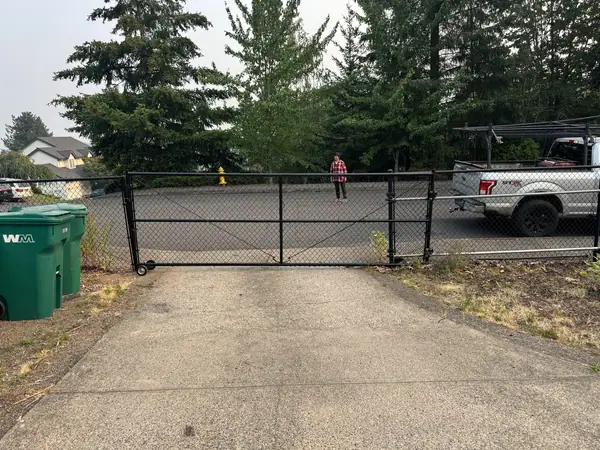
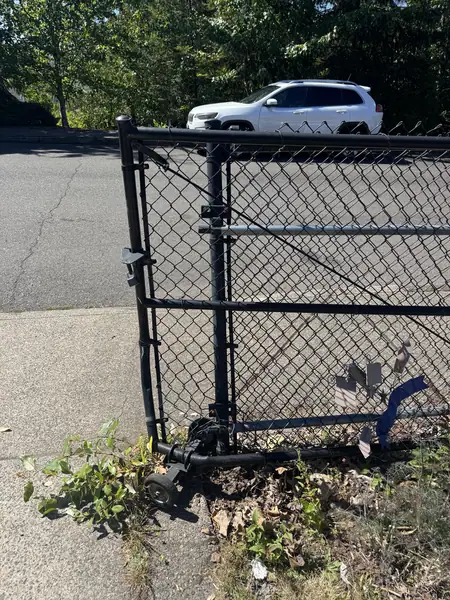
When the frame is twisted along much of its length, most of the bars are damaged, or cutting into an older gate shows rust has thinned the tube walls, a new gate is often the better use of the money. It is also a chance to fix what the old gate got wrong, such as open slide gate panels that ASTM F2200 says must be screened so a hand cannot reach through. Chain link is usually repaired on site, not in the shop. On one chain link repair in Happy Valley, the bent driveway gate sat beside a fence leaning off its posts. We set new posts in concrete, rebuilt the gate to close square, and pulled the fence run along the sidewalk back into line in one afternoon.
- Chain link gate frames are galvanized pipe, welded or joined with fittings, so a bent member can often be replaced instead of the whole gate.
- Fence runs beside the gate take damage too: bent line posts, kinked top rail, stretched or torn fabric.
- Loose fabric can usually be re-stretched on new posts; a torn or badly stretched section gets new fabric woven in.
Checks before the gate goes back into automatic service
A repaired gate going back on its operator is not finished until the operator and safety devices have been tested with it. The impact may have damaged parts nobody can see from the driveway, and a rebuilt gate can weigh and move a little differently than it did before. UL 325 calls for monitored entrapment protection, and a gate shouldn't run automatically until every device has been proven to work. We never bypass a damaged sensor to get a gate moving.
- The gate moves freely by hand through its full travel before the operator is re-engaged
- Open and close limits reset, and force settings checked against the repaired gate
- Photo eyes realigned and tested, with any cracked lens or bent bracket replaced
- Contact edges inspected and tested; an edge that took the hit can look intact and still fail to trip
- Reversal tested in both directions of travel
- Vehicle loops checked if the pavement around them cracked, and missing warning signs replaced
Frequently asked questions
Do I have to wait for an insurance adjuster before anything is touched?
Make the site safe right away; that never waits. Beyond that, ask your insurer, or the driver's, what they need before repair work starts. Some want to inspect the damage or collect their own estimate. Good photos taken before anything was moved, the broken parts kept aside, and a written, itemized repair quote cover most of what people get asked for.
The gate is bent but the post looks fine. Should the post be checked anyway?
Yes. A hard hit transfers through the hinges into the post, and a post can move in its concrete or crack its footing without leaning enough to notice. If a straightened gate goes back on a post that shifted, it will sag or bind again and the operator will fight it. We check posts for plumb and look at the footing at grade before rehanging anything.
Can a bent sliding gate be repaired, or does the whole panel go?
Usually repaired. The panel comes off, goes to the shop, and gets the same treatment as a swing gate: damaged bars and rail sections replaced, frame brought back straight, then refinished. What slide gates add is the running gear. Rollers, roller carriages, the track and the gear rack all get inspected, because a straightened panel on a damaged roller still binds.
Can my existing operator go back on the repaired gate?
Often, yes, if the operator came through undamaged. When we repaired a bent storage facility gate in Wilsonville, it went back on its existing LiftMaster operator. We check the arm, the bracket, the mounting pad and the drive, and test the operator under load once the gate is back. If internal parts were damaged when the gate was shoved backward, that's a separate repair or replacement decision we'll explain on site.
How long will my gate be out of commission?
It depends on the repair. Chain link work done on site can be quick: a bent chain link gate and fence run we repaired in Happy Valley took one afternoon. A steel gate that goes to the shop for new bars, sandblasting and powder coat takes longer; a bent storage facility gate we rebuilt in Wilsonville took about three weeks from first visit to back in service. If a post has to be reset in new concrete, that can add time too.
 Before
 Before
 Before