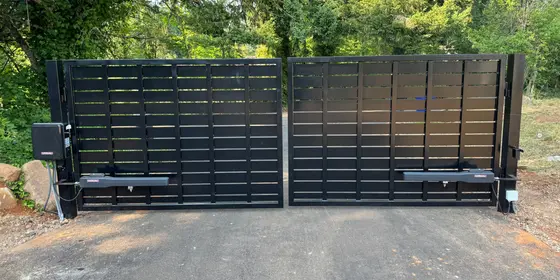
Why power is often the biggest job on the site
On a suburban lot the gate often sits a short run from a garage or house wall, and power barely shows up in the quote. Out on acreage it can be the largest single piece of site work on the job. The gate goes where the drive meets the road, while the panel, the house and the barn sit a long way back. Every foot between them is either trench or a reason to look hard at solar. That's why we settle power on the first site walk. It moves the schedule, the amount of ground that gets torn up, and the number on the quote more than most people expect.
What a gate operator actually runs on
Most modern residential operators run a low-voltage motor, and many run it straight from a battery. That battery gets charged one of two ways: by a transformer or charger connected to a power source, or by a solar panel. On a hardwired gate the source might be a circuit at the house, garage or barn with low-voltage wire run out to the operator, or a circuit brought all the way to the gate. Some operators, heavier commercial units especially, run on line voltage at the gate. Any line voltage work, from a new circuit to a new outlet, is for a licensed electrician. The battery also decides what happens when the grid goes down.
- On a battery-driven operator, the battery doubles as backup: in an outage the gate keeps running for a limited number of cycles.
- On many operators, outage behavior is a setting: stay closed when the battery runs low, or open and stay open.
- Batteries are a wear item. An old one can run the gate fine on grid power and quit a few cycles into an outage.
- A gate that starts moving slowly can mean a battery that is no longer being recharged. Have the charger or panel checked.
Trenching: what happens on the ground
A trench for gate power is simple in concept and fussy in practice. It starts at the nearest building with usable power, which is not always the house: a barn or shop closer to the road can shorten the run a lot. From there the conduit follows the easiest ground to the hinge post, and the route matters as much as the length. Here is what a well-planned run looks like.
- Locate before digging. In Oregon and Washington that means calling 811 and waiting for the utilities to mark their lines.
- The 811 locate marks utility-owned lines. Private lines past the meter, like a feed to a shop, a well line, irrigation or septic, usually go unmarked, so tell us what you know is buried.
- Conduit, not loose wire in the dirt. It protects the wire from shovels and roots, and lets it be replaced later without digging again.
- Following the driveway edge is usually the cleanest route: easy to find later, and nothing gets cut out of the drive.
- Crossing the driveway is the costly part: dig and regrade under gravel, cut and patch or bore under asphalt and concrete.
- Plan for restoring the surface, including topping off the backfill if the trench line sinks after the first heavy rains.
- Spare conduit is cheap while the trench is open. One extra run for a future keypad, intercom or camera saves digging twice.
How distance changes the answer
Distance hits a hardwired gate twice. The obvious cost is the trench itself: more digging, more conduit and wire, more surface to restore, and more chances of hitting rock, roots or a stretch of drive that has to be crossed. The less obvious cost is electrical. Low voltage loses strength over a long wire, so past a certain run the plan has to change, with heavier wire or with line voltage carried most of the way out by a licensed electrician and converted near the gate. Plenty of long runs are still worth trenching. But a gate several hundred feet down a gravel drive is exactly where solar earns a serious look. A short run from a nearby wall almost always favors hardwiring.
Solar: what it takes, and where Northwest weather pushes back
A solar gate is a self-contained system: a panel on a post or on the gate, a battery bank in or beside the operator, and an operator built to run efficiently on battery. Nice/Apollo and Mighty Mule both offer solar-ready operators. The battery runs the gate all the time, and the panel's job is to put back what each day takes out. Here the hard months are December and January, when daylight is short and the sky can stay gray for a week. A system that is fine in July can run flat by midwinter if it was sized for summer sun. These are the limits to check before choosing solar.
- Shade: tall firs along a drive can keep a panel in shadow most of a winter day, when the sun rides low in the southern sky. A panel on a post in a clearing can help, within limits.
- Cycles: every open and close draws down the battery. A handful a day suits solar; a shared drive with deliveries and visitors may not.
- Around-the-clock loads: an intercom, cellular unit, lit keypad, magnetic lock or heater draws power whether the gate moves or not, and can outweigh the motor.
- Cold: batteries deliver less in a cold snap, which tends to arrive with the shortest days.
- Upkeep: needles, pollen and moss on the panel cut its output, and batteries get replaced on schedule.
Plan the power before the paving and planting
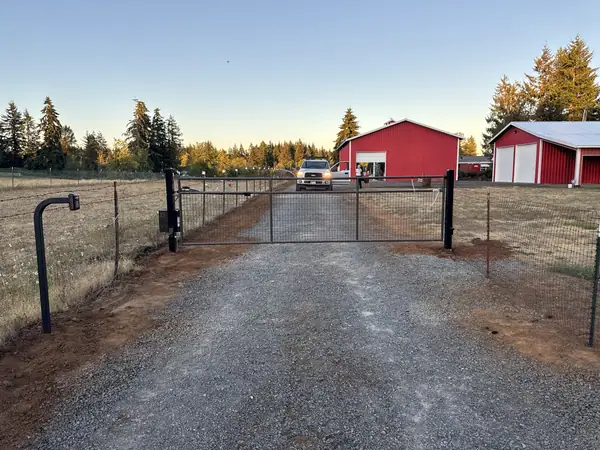
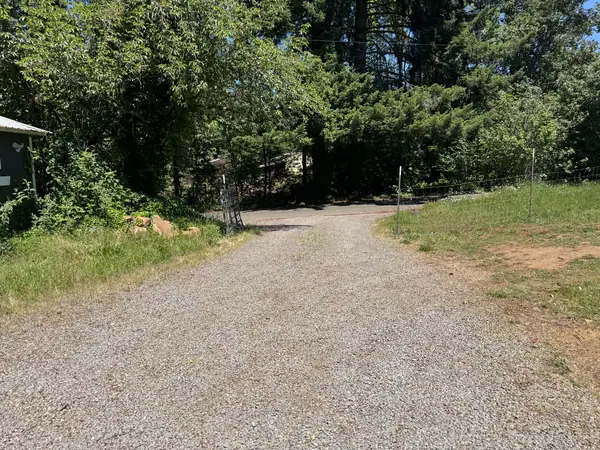
The cheapest trench is dug before anything goes on top of it, or routed where the new surface never has to be cut. If a new driveway, concrete apron or landscaping is coming, settle the gate's power route first, even if the gate is a year away. Near Beavercreek, new paving was on the way for a long rural driveway. We built the gate leaves from raw steel in our shop, waited for the paving, then hung them and trenched conduit along the driveway edge. In Mill Plain, we opened the ground for a side-yard gate's wiring a few days into the job, and the finished gate has fresh concrete poured in front of it.
Which one fits your property
Every site gets its own walk, but most properties we see fall into one of these patterns. The deciding questions are always the same: how far is the nearest usable power, what is in the way, how much sky does the gate post see in winter, and how many times a day will the gate open. Here is the short version.
- Suburban lot: hardwire. The run is short, a backup battery covers outages, and solar rarely pays off when power is a few steps away.
- Acreage with a barn or shop near the gate: trench from the outbuilding, once an electrician confirms its supply can take another load.
- Long gravel drive with no building near the gate: solar is often the practical choice for a low-traffic gate under open sky. Heavy shade, high traffic or an intercom and magnetic lock push it back toward a trench.
- Busy shared drive or commercial entrance: hardwire, in almost every case. Constant cycling, access control and a heavier operator need steady power a winter panel won't supply.
- Not sure: we walk the route with you, check the sky over the post, and quote whichever way fits.
Frequently asked questions
Can my gate run off power from the barn or shop?
Often, and on acreage it is frequently the shortest route. The questions are whether the outbuilding's supply can take another load and whether its wiring is in good shape, and a licensed electrician answers those. From there, conduit runs from the building to the gate along the easiest ground. On the Beavercreek farm gate we installed, the barn was the power source and the trench followed the drive.
Who does the electrical work on a new gate?
It splits in two. Line voltage work, such as a new circuit, breaker or outlet, has to be done by a licensed electrician, and a new circuit typically needs an electrical permit. The trench, conduit and low-voltage wiring out to the operator are gate work, and we handle them. The written quote spells out who does each piece, so you know up front what the electrician's part covers.
Can a solar gate be switched to hardwired power later?
Often, yes. Many battery-driven operators can take their charge from either a solar panel or a charger fed by a power source, so a later trench may only change the charging side, not the whole operator. It depends on the model, so if you expect power to come closer to the gate in a few years, tell us up front and we can choose an operator that keeps that option open.
Should I lay conduit now if the gate is still a few years off?
If you are paving, pouring concrete or landscaping across the likely route, yes. Empty conduit with a pull string, run from the power source to roughly where the hinge post will stand, saves cutting new surfaces later. Ask us or your electrician for the conduit type and burial depth first, since a run that may carry line voltage has to meet code. Photograph both ends with a tape measure in the shot and keep the pictures with your house papers. Call 811 before digging, even for a short run.
What does a dark, cold week do to a solar gate?
It is the real test. Short days and heavy cloud mean the panel puts back less than the gate uses, and cold cuts how much the battery can deliver. A well-sized system rides through on its battery bank. An undersized one slows, then stops, and on many operators a low battery triggers whatever outage behavior was set: stay closed, or open and hold. Keep the release key handy and the panel clear of needles and snow.
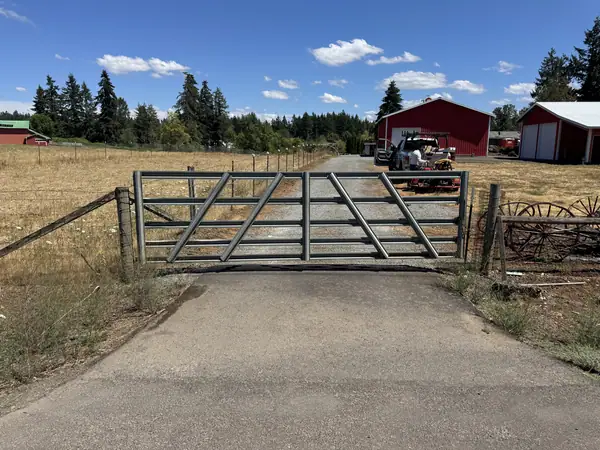 Before
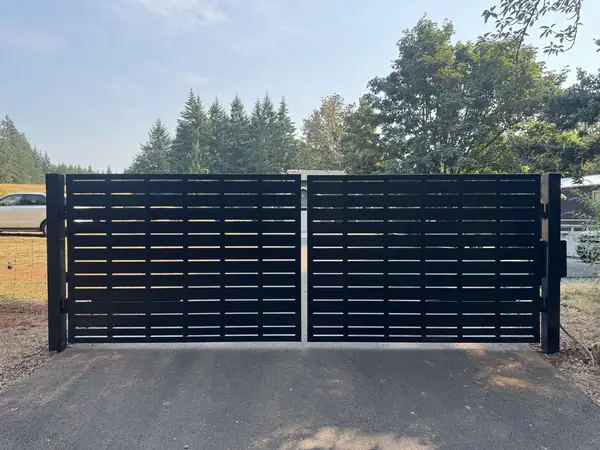
 Before